Small hanging skin tags on the neck, hard white dots under the eyes that won’t go away, a rough wart on a finger that keeps coming back… These are some of the most common reasons people see a dermatologist. Just as often, people first try to deal with them at home with iodine, thread, “patches” or squeezing. Here we explain what these lesions are, why home methods often do harm, and how they are removed safely in clinic.
First: what exactly do you have?
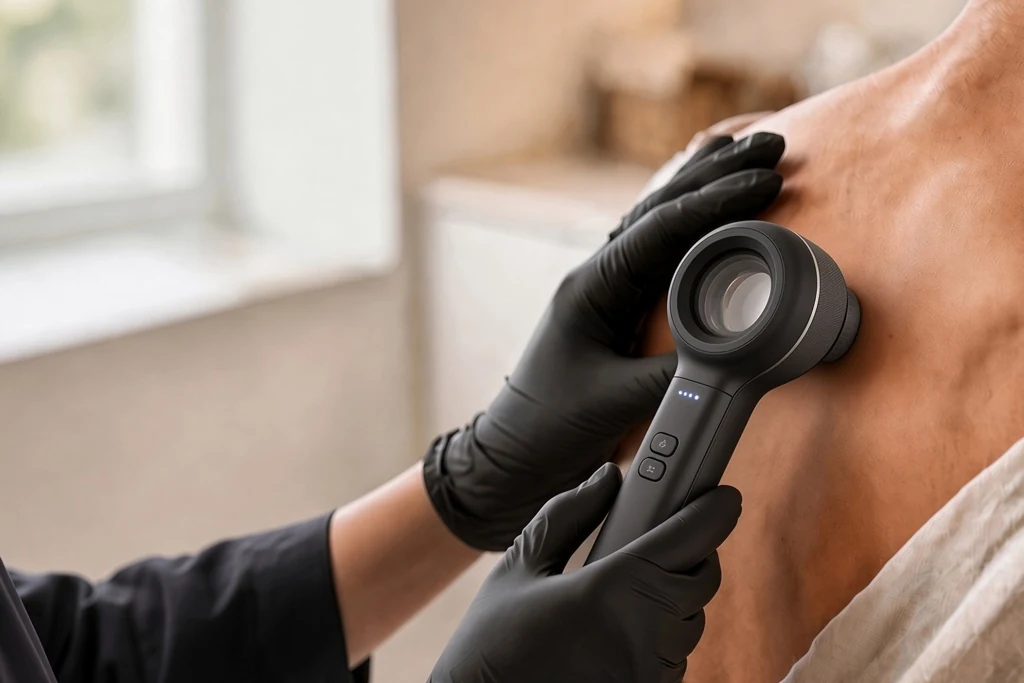
The most important step is not the removal itself but the right diagnosis. Different lesions can look alike at first glance, and the removal method depends on the type. That is why at Dermique every lesion is first examined by a dermatologist, with a dermatoscope when needed.
Skin tags (soft fibromas)
Skin tags are small, soft, hanging growths, skin-coloured or slightly darker. In Bulgarian they are often called “papillomas”. Their medical name is acrochordon or soft fibroma. They appear most often where skin rubs: on the neck, armpits, eyelids, under the breasts and in the groin. They are benign, but they can catch on clothing or jewellery, become inflamed or simply bother you.
Milia
Milia are tiny, hard, white or yellowish “pearls”, most often under the eyes, on the eyelids and on the cheekbones. They are not pimples. They are small keratin-filled cysts “sealed” beneath the skin surface with no opening. That is why squeezing doesn’t work. It only damages the skin and can leave a mark or cause infection.
Warts
Warts are viral growths caused by the human papillomavirus (HPV). They are usually rough, with tiny “seeds” on the surface, and appear most often on the hands and feet. They can spread on the same person or to others, and they often return if not treated properly.
Seborrhoeic keratoses
Seborrhoeic keratoses are brownish growths that look “stuck on” the skin, with a waxy or rough surface. They become more common with age. They are benign, but they sometimes resemble moles, so it is important to have them checked.
Why home methods are a bad idea
- Tying off with thread or cutting can cause bleeding, infection and scarring, especially if the lesion is misjudged.
- Iodine, acids and pharmacy “solutions” applied without control can burn the healthy skin around the lesion.
- Squeezing milia almost never works, but often leaves red marks and scars.
- Riskiest of all, you can’t be sure what you are removing. A lesion that looks harmless sometimes needs a professional assessment before it is removed.
How we remove benign lesions at Dermique
The method depends on the type, size and location of the lesion, and is chosen only after an examination. We use gentle, non-surgical techniques, with no incisions and no stitches:
- CO2 laser. With the eCO2 laser we precisely remove skin tags, milia and some superficial benign lesions. The method suits delicate areas such as the eyelids and neck.
- Curettage. The superficial lesion is carefully removed with a special instrument called a curette. This suits, for example, some seborrhoeic keratoses.
- Cryotherapy with liquid nitrogen. The lesion is frozen in a controlled way. This is used for certain superficial lesions.
- TCA 100% (trichloroacetic acid) for warts. The doctor applies it precisely to the wart only. Several sessions are often needed, because warts are viral and stubborn.
Local anaesthesia is used when needed, so the procedure is usually well tolerated. Healing depends on the method and the size of the lesion. Usually a small scab forms and falls off on its own. You will get specific aftercare instructions.
What to expect after the procedure
- The area may be slightly red or swollen for the first few days.
- Don’t pick the scab. Let it fall off by itself to reduce the risk of a mark.
- Keep the area clean and dry and follow your doctor’s instructions.
- Protect the area from the sun while it heals, and keep using sunscreen afterwards.
- For warts, expect several sessions. Your doctor will decide the interval.
If you notice increasing pain, warmth, pus or spreading redness, contact us.
When a lesion should not simply be “removed”
Any lesion that grows, changes colour or shape, bleeds, crusts, itches, hurts or looks different from the others should first be examined by a dermatologist. In these cases diagnosis comes before cosmetic removal. We start with dermoscopy of moles and lesions. If we decide a lesion needs surgical removal and testing, we will refer you to the appropriate specialist.
Can I prevent new ones?
- A tendency to skin tags is often hereditary and linked to friction, excess weight and hormonal changes such as pregnancy. It cannot always be prevented.
- If you are prone to milia, avoid very heavy eye creams. Discuss suitable exfoliating care with a dermatologist.
- To avoid warts, don’t walk barefoot in public pools and showers, don’t pick at a wart, and don’t share towels.
- Use sun protection and check your moles regularly.
Learn more about the lesions we treat on our Skin lesions page.
Frequently asked questions
Does removal hurt?
Local anaesthesia is used when needed, so the procedure is usually well tolerated.
Will it leave a scar?
Usually a small scab forms and falls off on its own. The risk of a mark depends on the size and location of the lesion and on following aftercare. You will get specific instructions.
Can I squeeze a milium myself?
It is not recommended. Milia have no opening, so squeezing usually doesn’t work and can cause scarring or infection.
Why does my wart keep coming back?
Warts are caused by a virus and are stubborn. Several sessions of TCA 100% are often needed, and avoiding picking and shared towels reduces the risk of reinfection.
Do I need an examination for a small lesion?
Yes. The method depends on the type of lesion, and any lesion that is changing should be examined first, with dermoscopy when needed.
Book a consultation at Dermique
If you recognise yourself in this article, the best first step is an examination by a dermatologist. Fill in our enquiry form and our team will contact you to confirm a convenient time. You can also reach us via our Contact page. Current prices are on our price list.
This article is for information only and does not replace a medical examination. The choice of treatment and expected results are individual and are decided after a consultation.